From quanta to cultures
All information
The Munich Excellence Mile
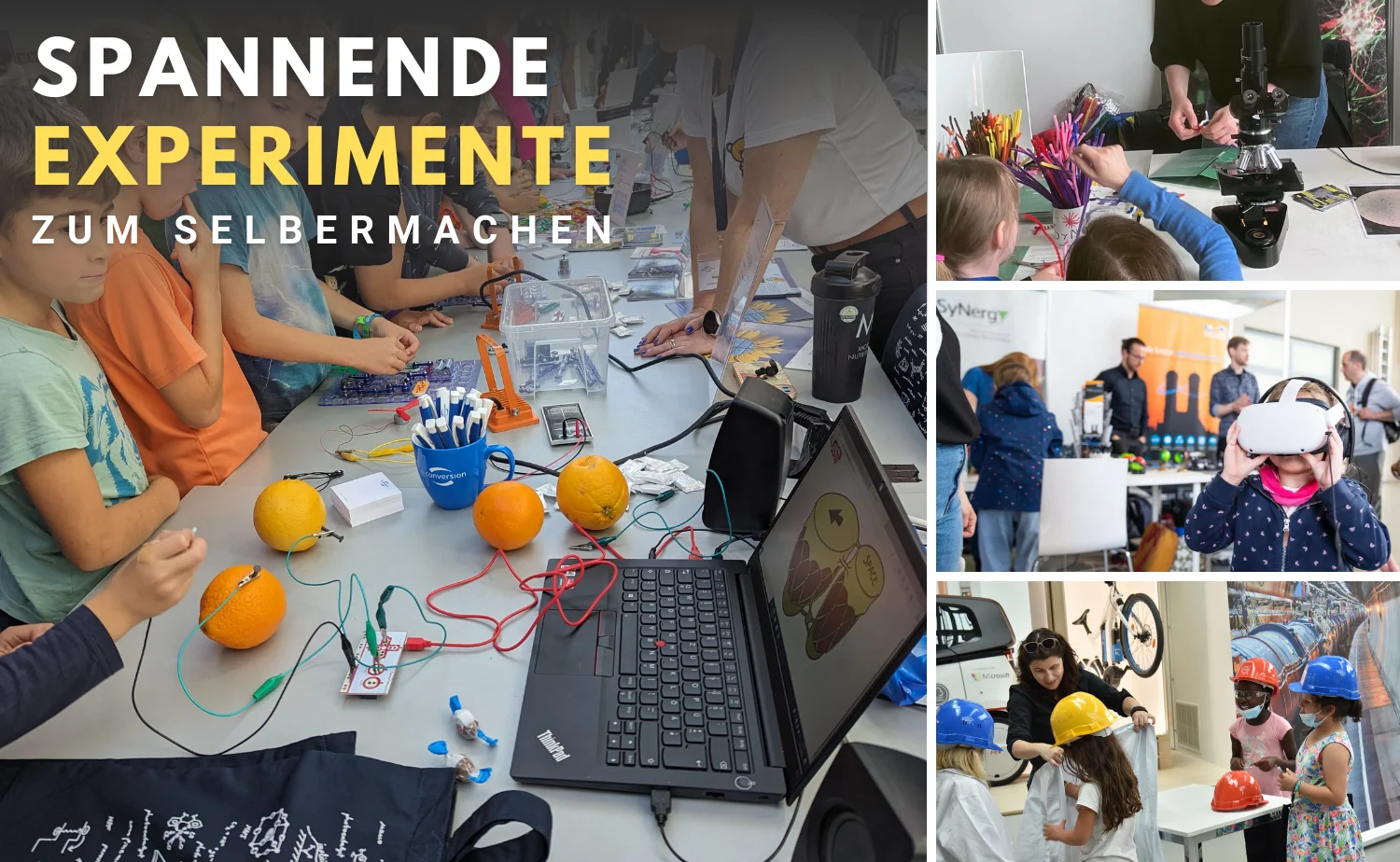
Where will we get our energy from in the future? What is a quantum computer? What makes biological functions functional? And what actually happened after the Big Bang? How was knowledge passed down over the millennia? The researchers at the Munich Cluster of Excellence are dealing with these and many other questions BioSysteM, Cross-Cultural Philology, e-conversion, MCQST, NUCLEATE, Transform and ORIGINS. Exciting experiments to do yourself and lots of information about Munich's cutting-edge research await you at our stands. Go on a journey of discovery with your researcher pass, solve seven tricky challenges and win one of our prizes at the end!
Cluster of Excellence BioSysteM
Our body does amazing things to live: it transports materials better than a logistics company, builds structures more precisely than any architectural firm and reacts more reliably than many technical systems. BioSysteM, researches how the building blocks of life can be controlled, imitated and used - from individual molecules to mini-organs.
- Become a bio-designer yourself and decide on a vital function.
- Crack the DNA code.
- Make your own protein keychain.
Cluster of Excellence Cross-Cultural Philology
How was knowledge passed on over the last 5,000 years, who decided on it and what role did languages and texts play worldwide? In the Cluster of Excellence Cross-Cultural Philology, 25 humanities subjects combine their perspectives - from Egyptology to the history of science - and jointly research the cultural history of humanity.
- Experience the diversity of languages and characters around the world.
- Assign different texts to the right time and place.
Exzellenzcluster e-conversion
In order to use the energy from sun, wind and water, we have to convert and store it. e-conversion is researching the basics of these processes so that both can run more efficiently in the future, because with every conversion a considerable part of the energy is lost at interfaces. The savings potential is enormous
- Discover the secrets of light and polarization filters.
- Play a game of Solar Pong.
- Elicit your own melodies from the cucumber piano.
- Find out more about researchers of the past in a short radio play.
Exzellenzcluster MCQST
MCQST – the Munich Center for Quantum Science and Technology – researches the smallest particles in the universe and brings them directly to you. Phenomena like superposition, where particles are in two places at once, and entanglement, which connects them over large distances, are not science fiction, but real quantum physics.
- Experience the quantum world in a playful way - with classics like Tic-Tac-Toe or Memory, but according to the rules of quantum physics.
- Virtually immerse yourself in a real research laboratory using VR glasses.
- Meet researchers and ask them everything you always wanted to know about quantum physics.
- Discover the exciting world of quantum in workshops.
Cluster of Excellence NUCLEATE
DNA and RNA are the superheroes in all living things: They store information, send messages and control what happens in cells - in humans as well as in bacteria or worms. NUCLEATE studies these tiny molecules to better understand diseases and develop new therapies.
- Test your knowledge of DNA and RNA and spin the wheel of fortune.
- Make bracelets from the Code of Life.
Cluster of Excellence TransforM
How is technology changing our society – and who is helping to shape this future? TransforM explores the social, cultural and economic impacts of technological transformation. Together we think about the world of tomorrow.
- Go through three sector stations – Economy & Industry, Environment & Health and Art & Culture – and ask yourself: Who benefits from technological progress – and who is left behind? What does “being healthy” mean in the future? Who owns culture – people or algorithms?
- Write down your thoughts, ideas and open questions sketchily on large sheets of paper.
- Connect the three areas with a common thread - and discover how business, health and culture are inextricably linked.
Cluster of Excellence ORIGINS
What is Dark Matter? Where do the stars and galaxies come from? How did life originate on Earth and is there life elsewhere in space? The ORIGINS Cluster is researching precisely these and other questions with over 100 working groups from the fields of astrophysics, biophysics and particle physics, chemistry and geosciences.
- Make “fridge magnets” with pictures of galaxies and planets for at home.
- Have a selfie taken of you - straight from the tunnel of CERN's famous LHC particle accelerator.
- Use XR applications to investigate fascinating astrophysical phenomena in our solar system or distant exoplanets.
- Explore the inner workings of the Belle II particle detector and analyze real particle decays with a three-dimensional representation.
- Especially for teachers: Find out about lectures or teaching materials that ORIGINS provides.
© ORIGINS/Synergy/MCQST/e-conversion